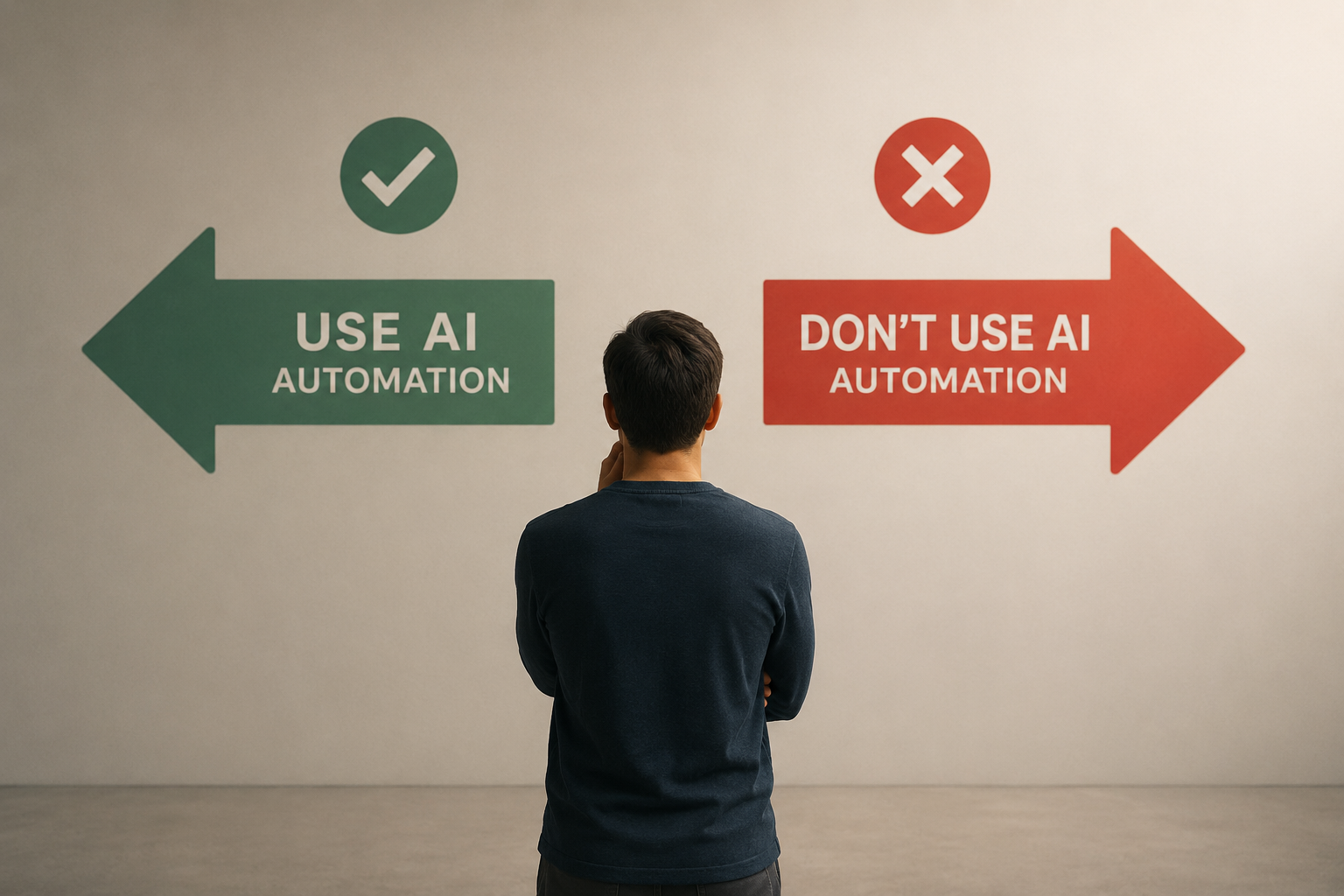
When (and When Not) to Use AI Automation
A practical decision framework for business process automation ,knowing when agentic AI and workflow automation genuinely help, and when human-in-the-loop oversight is non-negotiable.
It's 9 PM. A customer messages asking about order status. Your inbox has 40 more messages like it, plus an angry email about a lost shipment, and a first-time buyer on the fence who needs a thoughtful reply to close.
Which of these should a bot handle, and which needs a human? That's the core of automation readiness, not "should we use AI automation" but "where exactly does it belong." Most businesses get this wrong: they automate everything and watch trust erode, or automate nothing and drown in repetitive work that was never worth a human's time.
Automation Isn't Binary
Automation is a tool excellent for some jobs, harmful for others. Teams that wire AI into every workflow often realize too late that some of it needed judgment, empathy, or accountability the system doesn't have. The output looks efficient on a dashboard, but customers feel it, and trust quietly erodes.
The opposite mistake is just as costly: avoiding automation entirely keeps employees stuck on repetitive work a system could handle in seconds. The fix isn't picking a side — it's a filter for deciding, task by task, whether automation helps or hurts.
When AI Automation Works Well
It's repetitive and happens at volume. Answering the same three questions fifty times a day isn't a job for a human. High frequency, low variation is the clearest sign a task is automation-ready.
The rules are clear and stable. If you can draw the whole process on a whiteboard without hitting an unexplainable fork, it's ready.
The cost of a mistake is low. A late reminder is no big deal; auto-declining a loan application isn't. This is where AI automation risks match the autonomy you give a system to how much damage a wrong call could do. It's the same logic behind human-in-the-loop design: automate the low-stakes decisions, and insert a person where mistakes actually hurt.
The workflow is already documented and stable. A process run the same way for months is a strong candidate. One still evolving means more time patching the automation than it saves.
When AI Automation Backfires
It needs real judgment. Negotiating a contract or handling an escalation requires reading between the lines. AI can draft a response; it shouldn't handle a furious customer alone. This is where agentic AI needs a human-in-the-loop checkpoint, not full autonomy.
The underlying process is broken. Automating a bad process just makes mistakes happen faster. Process redesign has to come before workflow automation, not after.
The data is messy. Outdated records or inconsistent fields mean an AI system won't fix the mess quietly, it'll confidently produce wrong answers, faster. This is one of the most common AI automation limitations teams underestimate.
No one is accountable for the outcome. A system can execute a decision but can't own the consequences. Someone specific needs to own what happens if it goes wrong.
A Quick Framework You Can Use
Run any task through this AI automation checklist:
How often does this happen? Frequent → good candidate. Rare → probably not.
Do I understand the process today? Can't explain it step by step? Stabilize it first.
What's the cost of a wrong output? Low stakes → light oversight. High stakes → human review.
Does it need judgment or empathy? If yes, automation should assist, not replace.
Is the data clean? Garbage in, garbage out, automation just makes it faster garbage.
Score well on all five, and it's ready to automate. Fail one or two, and it needs a human in the loop.
Assist vs. Replace
Most mature teams land on a middle ground: AI drafts the email while a person hits send, or flags ready-to-buy leads while a rep makes the call. This "assist mode", the practical shape of human-in-the-loop design captures most of automation's speed without handing over decisions that need a human perspective. As trust builds, autonomy can shift gradually from supervised workflow automation toward more independent agentic AI.
The Takeaway
AI automation isn't a strategy in itself, it's a tool that's excellent for some jobs and wrong for others. The teams that win with it know exactly where to draw the line: automate the repetitive, low-risk work eating up hours for no good reason, and keep humans in charge of anything needing judgment or accountability. This holds whether you're exploring AI automation for small business or running full business process automation at scale.
Before your next automation project, don't ask what AI can do. Ask what the task actually needs and let that answer decide.